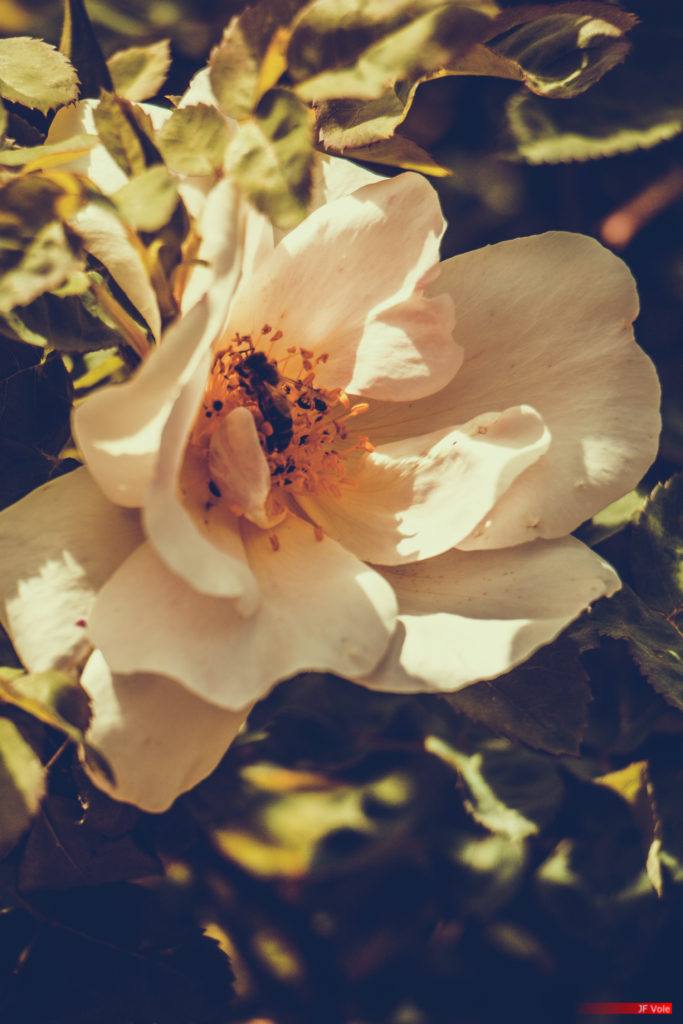
Jardin de Claude Monet, Giverny, juin 2019.lens : EF-S18-135mm f/3.5-5.6 IS STM; flash : éteint, pas utilisé;
Références : * Apidae - Wikipédia : Les Apidés (Apidae) forment une famille d'insectes de l'ordre des hyménoptères. Il s'agit de la famille d'abeilles la plus large et diversifiée, avec plus de 5 700 espèces. * Claude Monet - Wikipédia : Claude Monet, né sous le nom d'Oscar-Claude Monet le 14 novembre 1840 à Paris et mort le 5 décembre 1926 à Giverny, est un peintre français et l’un des fondateurs de l'impressionnisme. Il commence sa carrière d'artiste en réalisant des portraits-charge des notables de la ville du Havre. * Fondation Claude Monet - Maison et jardins de Claude-Monet - Giverny : Ouvert du 1er Avril au 1er Novembre. La maison et jardins de Claude-Monet - Giverny est le lieu le plus visité en Normandie après le Mont Saint-Michel. Depuis 2010 où on décompte 530 000 visiteurs, la fréquentation augmente atteignant 570 000 en 2012 puis 580 000 en 2013 pour atteindre 750 000 visiteurs en 2023, ce qui conforte sa deuxième place de site touristique de Normandie. Propriété de l'Académie des beaux-arts, la maison et les jardins ont reçu respectivement les labels « Maisons des Illustres en 2012 » et Jardin remarquable en 2011. La propriété fait l'objet d’une inscription au titre des monuments historiques depuis le 26 avril 1976. Maison et jardins de Claude-Monet - Giverny sur Wikipédia (fr) Fondation Monet in Giverny : The Fondation Claude Monet is a nonprofit that manages the house and gardens of Claude Monet in Giverny, France, where Monet lived and painted for 43 years. Monet was inspired by his gardens, and spent years transforming them, planting thousands of flowers. He believed that it was important to surround himself with nature and paint outdoors. He created many paintings of his house and gardens, especially of water lilies in the pond, the Japanese bridge, and a weeping willow tree. With a total of 530,000 visitors in 2010, it is the second most visited tourist site in Normandy after the island of Mont Saint-Michel. The house and gardens have been listed among the Maisons des Illustres and classified as a Jardin Remarquable. The estate was classified as a monument historique in 1976. Monet's paintings of the gardens, especially the sites' pond with water lilies, are exhibited in dozens of major collections. Fondation Monet in Giverny sur Wikipédia (en) * Photographie animalière - Wikipédia : La photographie animalière consiste à prendre un cliché d'un animal, ou de plusieurs, en liberté. La déontologie de la photographie animalière exige que l'animal soit dans son milieu naturel ; qu'il n'y ait aucune perturbation de la vie animale ; que l'image traduise une scène naturelle, sans artifice. * Photographie de paysage - Wikipédia : La photographie de paysage est un genre de photographie dont l'objet est la prise de vue de paysage. Elle est, avec la photographie de famille et le portrait, un des genres de photographie artistique les plus pratiqués par les photographes amateurs. * Proxiphotographie - Wikipédia : La proxiphotographie ou « photographie de près » est l'ensemble des techniques photographiques permettant de photographier des sujets de petite taille sans atteindre la macrophotographie. On parle souvent dans ce cas d'un gros plan. * Romneya - Romneya : Romneya () is a genus of flowering plants belonging to the poppy family (Papaveraceae). There are two species in the genus Romneya, which was named for Irish astronomer John Thomas Romney Robinson. They are known commonly as Matilija poppies ( mə-TIL-i-hah), bush poppies, California poppies, or tree poppies. The common name "Matilija" is said to come from the Chumash leader, Chief Matilija. They are also known as the "fried egg flower" or the "fried egg plant" due to their bright yellow stamen, which creates the image of a sunny-side-up egg. They are native to chaparral and coastal scrub habitats in Southern California and Baja California. They are perennial subshrubs with woody stems. They may grow to a height of 2.5 meters (8.2 feet) and a width of 1 m (39 in), with the flowers up to 13 cm (5.1 in) across. The silvery green leaves are deeply cut, with a small fringe of hairs at the margins. They are notable for their large, satiny white flowers and intense boss of yellow stamens, blooming in late spring and summer. Their thin white petals have a satiny crepe-like texture. Romneya produce the largest flowers of any members of the poppy family. These flowers prefer a warm, sunny spot against a south-facing wall with fertile soil with good water drainage. They are not easily grown but once established are difficult to remove. In the wild, they are known as "fire followers" because they need smoke to germinate and can be frequently, but not exclusively, found in burned areas. When these flowers are grown on a hillside, they can act as a soil binder and prevent erosion. Matilija poppies were reportedly used medicinally by the Chumash to treat skin and gum problems, and stomach aches. The two species are: Romneya coulteri Harv. – Coulter's Matilija poppy Romneya trichocalyx Eastw. – Bristly Matilija poppy. Some consider this a variety of Romneya coulteri, but it is accepted in recent manuals. Romneya sur Wikipédia (en)